iPaulina
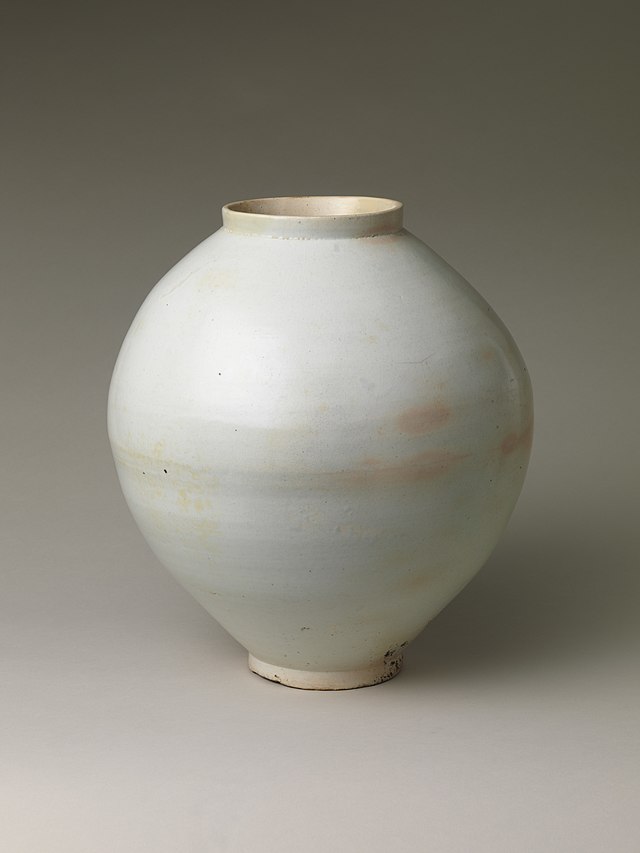
Korean moon jars: history and symbolism
Moon jars are a distinctive type of traditional Korean pottery; they are characterised by a round, almost spherical shape, and a minimalist design of white porcelain.Moon jars are closely connected with the Joseon dynasty, which reigned over Korea from 1392 to 1897. Whilst white porcelain was popular in China, Japan, and elsewhere in Asia, moon jars are unique to Korea. Three moon jars are part of the South Korea National Treasury; the British Museum collection includes a moon jar dating back to the 18th century, which was brought to England by the influential and highly regarded British artist Bernard Leach in the early 20th century.
The creation of the moon jar was carried out by hand-throwing on a potter’s wheel or by coiling clay. As moon jars were too large to form a single piece on the potter’s wheel, the upper and lower hemispheres were made separately and then joined together. Unlike most Chinese jars, Korean moon jars are not smoothly trimmed, meaning that the junction between the two hemispheres is, to some extent, visible in the final product, as seen in the image. Moreover, when the jars were fired, they may have cracked or warped due to the connection of the two hemispheres, preventing the formation of a perfect sphere. The jar’s large, rounded shape required a high level of craftsmanship to ensure that visual balance and overall symmetry were maintained, especially considering that, traditionally, the base of the moon jar was smaller than the mouth. The jar’s shape has a sense of natural imperfection, meaning that it looks unique from different angles, despite its seemingly uniform appearance.
Moon jars’ white colour comes from baekja, a refined white kaolin clay containing no or very little iron dioxide, which would produce blue or green colours in the porcelain even in tiny quantities. The kaolin used in moon jars requires a very high firing temperature of at least 1300°C. Wood-fired kilns and reduction firing techniques were used; the reduced airflow inside the kiln, together with the glaze and slight variations in temperature, played a key role in determining the final appearance and finish of the porcelain. This added an element of unpredictability, encapsulated by the Korean word yobyeon, meaning ‘change in the kiln’. During reduction firing, oxygen in the kiln is limited, causing certain metals in the glaze to produce a slightly richer, darker colour in areas of the porcelain. This unique firing process results in slight cracks or variations in the glaze colour. The small imperfections, such as the minute, delicate cracks, the slightly irregular shape, and the uneven texture of the surface, make the jar seem organic in a way only found in nature. Moon jars’ imperfect beauty symbolises natural processes and places an emphasis on the acceptance and appreciation of flaws.
Though white porcelain had always been present in Korea, it was only in the 18th century that it started having the cultural importance that it retains today, as Korean ruling classes sought to develop a distinctive Korean culture and identity. Moon jars embodied the values of Chinese Confucianism, which was adopted by the Joseon dynasty during its five-century-long rule and influenced all aspects of Korean life, from governance to aesthetics. Confucianism places an emphasis on harmony, restraint, and contentedness, all of which can be linked to the visual and symbolic qualities of moon jars. For example, the Confucian concept of Li (Hanja: 禮) entails ritual propriety, manners, or the ‘right’ way of doing things. Li emphasises the importance of maintaining harmony and order in both social relations and the physical world; this balance is reflected in moon jars’ simple, harmonious shape. Self-restraint (Hanja: 自理) is another central concept in Confucianism. It is seen as a vital quality for achieving personal integrity and balance, discouraging greed and selfishness. Self-restraint also ties into Li, as it encourages a proper and balanced way of doing things, on both a larger scale in society and in everyday life. We can see this core ideal of Confucianism reflected in moon jars’ simplicity; their lack of decorative embellishment shows restraint in ornamentation and opulent decoration.
Furthermore, in Confucian thought, imperfection is seen as a natural part of life, and self-restraint is about accepting and embracing this natural imperfection. Moon jars’ natural flaws are a part of the beauty of the jar, rather than something that detracts from it. The acceptance of the jars’ natural imperfections can be seen as a reflection of the Confucian principle of humility. The artist acknowledges that perfection is not the goal, but rather that the pursuit of virtue and balance is more important. Moon jars also resonate with the concepts of um and yang in Korean (widely known as yin and yang in Chinese philosophy), which are the complementary forces that create balance and harmony. Overall, the symbolism of moon jars is beautiful and timeless, with an overarching message of appreciating flaws that ties into life more generally.
Céline (VI)
Photo: Moon Jar (백자대호 白磁大壺), 18th Century, CC0 1.0 Universal

The science behind altitude training

Should we scrap the House of Lords?

Simone Biles

Athletes as role models: responsibilities and pressures

The modern vampire

What relevance can the Magna Carta hold for us today?

Ethical issues of using AI in the IVF embryo selection process
