iPaulina
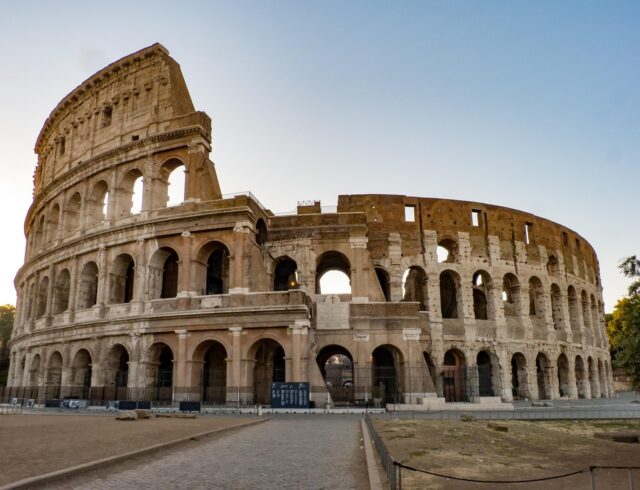
Why hasn’t the Colosseum fallen down? The secrets of Roman architecture
The Colosseum, also known as the Flavian Amphitheatre, is an amphitheatre built under the Flavian emperors of the Roman Empire. It stands four stories tall at its highest point, measures 620 by 513 feet (189 by 156 metres), and could hold as many as 50,000 spectators.Travertine and tuff were the two types of stones that were used to build the Colosseum. Travertine is durable, attractive enough to serve as an exterior finish, and can be shaped into neat large blocks. It was mainly brought from Tivoli quarries and is still used to this day as a building material. Tuff, meanwhile, is softer than travertine, making it easier to shape into blocks. Due to the poor condition of the soil beneath the amphitheatre, a deep and strong foundation was required to stabilise the structure before building. In general, a solid foundation is achieved by excavating down to bedrock or a strong layer of clay. The Colosseum’s foundation, with more than 12m thickness, was constructed by two layers made with ancient Roman concrete and embedded into deposits that contained gravel, sand, and volcanic sediment.
However, this does not fully explain how the Colosseum, and many other Roman buildings, have stood for over 2,000 years: modern concrete, which we use in everything from roads to buildings to bridges, can break down in as few as 50 years. Recently, scientists finally discovered why these Roman buildings have remained standing for so long: a special ingredient that makes the cement grow stronger, not weaker, over time.
Scientists began their search with an ancient recipe for mortar, laid down by Roman engineer Marcus Vitruvius in 30 BC. It called for a mixture of volcanic ash, lime, and seawater, combined with volcanic rocks and spread into wooden moulds that were then immersed in more sea water. History contains many references to the durability of Roman concrete, including a note written in 79 BC describing concrete exposed to seawater as ‘a single stone mass, impregnable to the waves and everyday stronger.’ But what did that mean? To find out, the researchers studied drilled cores of a Roman harbour from Pozzuoli Bay near Naples, Italy. When they analysed it, they found that the seawater had dissolved components of the volcanic ash, allowing new binding minerals to grow; and within a decade, a very rare hydrothermal mineral called aluminium tobermorite (Al-tobermorite) had formed in the concrete. Al-tobermorite can be made in a lab but is very difficult to incorporate into concrete. However, the researchers found that when seawater percolates through a cement matrix, it reacts with volcanic ash and crystals to form Al-tobermorite and a porous mineral called phillipsite, thus strengthening the concrete over time. All this goes to explain how the Romans built such long-lasting architecture that still stands today.
Rebecca (LV)

How is chemistry used in forensic science?

Non-crime hate incidents

Movie review: The Perks of Being a Wallflower

I am not and yet here I am: the fascinating world of cryptocurrencies

The US election: why did Trump win?

The neuroscience behind sleep and dreams: why do we sleep?

Mary Delany: The Making of Flowers as an Act of Sapphic Love
